Tuesday, March 27, 2018

Selma to Montgomery Voting Rights March

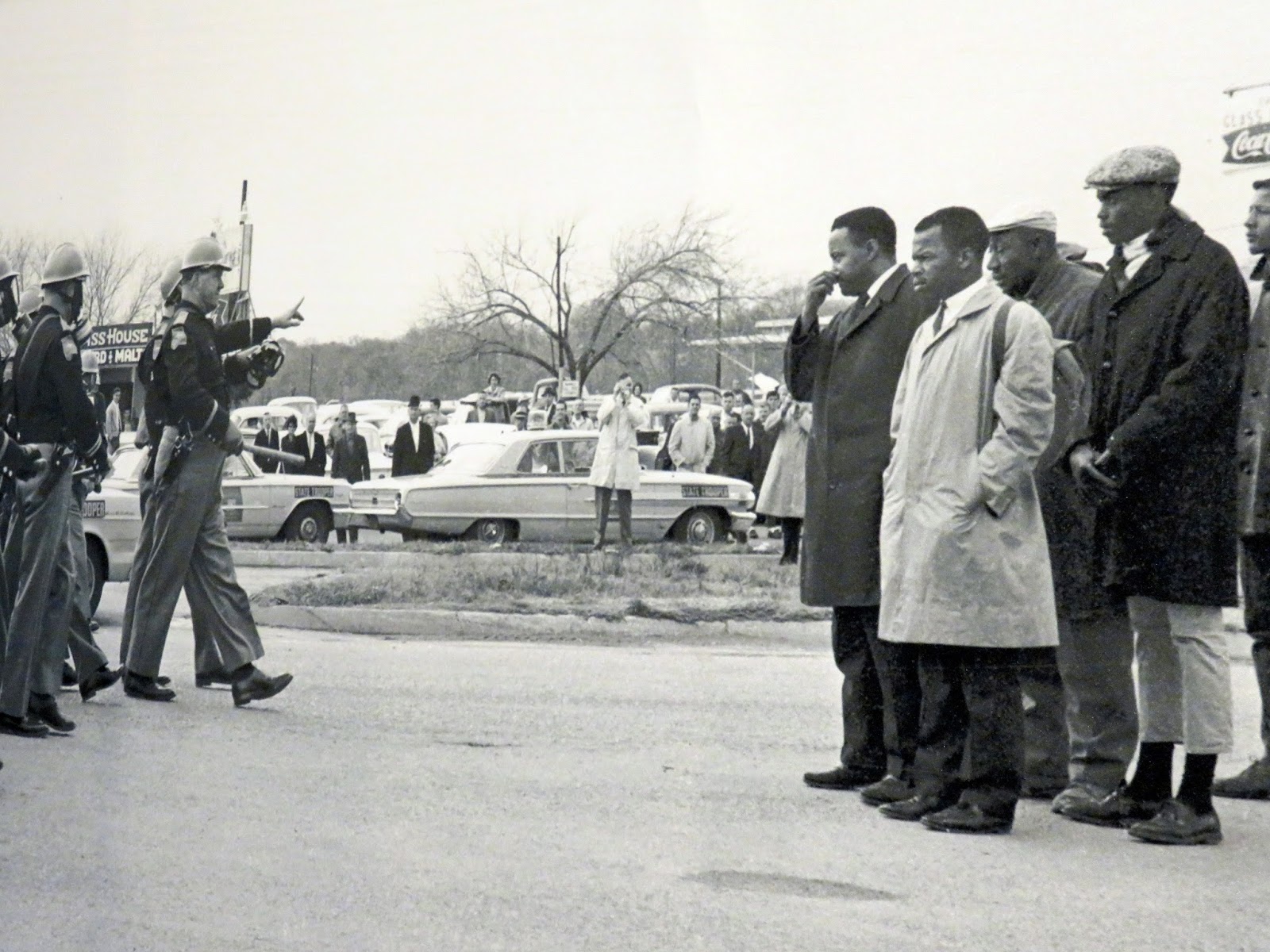
On March 7, 1965, over 600 people lined up by twos prepared to walk from Selma to Montgomery to protest voting rights violations.  Led by John Lewis and Hosea Williams, they walked through Selma peaceably, before state troopers met them at the Edmund Pettus bridge and ordered them to go home.
John Lewis (white coat) and others chose to stand still
Instead, they stood still.  The troopers swept forward, pushing the marchers back and knocking them to the ground.  Dogs were unleashed on them.  T
ear gas was sprayed.  As the marchers struggled to breathe, men on horseback - local deputies and posse members - joined in the assault, using cattle prods, clubs wrapped with barbed wire - and bullwhips! 
"Prods" used that day
 John Lewis suffered a skull fracture; fifty-seven others were sent to the hospital.  This day became known as “Bloody Sunday.” 
Jim and I visited Selma very close to the anniversary of “Bloody Sunday.”  We knew there was going to be a Bridge Crossing re-enactment and jubilee this year on March 3 and 4.  We debated whether to go then, or to go earlier in order to allow for more solitary reflection.  We decided on the latter.

U.S. Highway 80
So, on March 1, we left Montgomery and slowly drove U.S. Highway 80, going backwards along the fifty-four miles the marchers eventually walked.  I looked at the rural countryside and tried to imagine walking beside them -- spending four nights along the road, sleeping in ditches, on farmland and in a Catholic churchyard.  The ultimate Selma to Montgomery March helped win passage of the Voting Rights Act of 1965.  However, the story behind the march began much earlier than that.

State Constitutions amended to restrict Black voting 
As you recall, the Fifteenth Amendment guaranteed blacks the right to vote back in 1870.  But, in 1901, Alabama amended its state constitution with requirements that African Americans could not meet: such as literacy tests, comprehension tests, poll taxes (i.e. fees to vote) and grandfather clauses.  (“Grandfather clauses” – often used today to “protect” someone’s previous rights – were literally used here to exclude any person from voting whose grandfather had not voted namely, any descendant of an enslaved grandfather.)

Disenfranchisement – the denial of the right to rote – was swift.  Within one year, the number of black voters in Alabama dropped 98 percent!   Blacks who tried to vote faced threats, harassment, the loss of the jobs and even their lives.


When they tried to register to vote, the tests were applied very subjectively.  For example, a person recounted at the Selma museum that one comprehension question was: “How many bubbles does a soap bar make?”  For some “strange” reason, a black person always got the answer wrong.  By 1940, only 3 percent of Black Alabamans were registered to vote.  By 1961, a federal civil rights report revealed that, in Montgomery County, fewer than 1 percent of the voting-age black population was registered.  In another county, Blacks comprised more than 80 percent of the population, but none were registered.  Oh, disenfranchisement was effective! 

In 1964, voting registration campaigns and voting rights protests became more organized.  This all came to a head in the small town of Marion, Alabama.  On February 18, 1965, during a peaceful protest there against voting barriers, state law enforcement officers began once again to beat the demonstrators.  Jimmie Lee Jackson, a 26-year old Vietnam veteran and church deacon, was fatally shot when a state trooper attacked his mother and grandfather and he tried to defend them.  At his funeral, an outraged Reverend James Bevel urged the community “to march Jackson’s body to Montgomery, lay his coffin at the feet of the Governor and demand action”. 

March 7th was the date chosen for that first march – and, as I described earlier on, it became known as Bloody Sunday.  But, something new occurred that day, too.  For the very first time, national television broadcasts were interrupted to bring live coverage of the violence wrought upon the protesters.  The images stunned the nation.  A lawsuit quickly won stipulated that marchers were to receive police protection the next time. And, while the court order also said that only 300 could march from Selma, it went on to say that others could join them along the route.  Due in part to the televised coverage of the beatings, 8000 marchers poured in from across the country to walk some or all of the path to Montgomery.
           
With the protection of the National Guard, the ultimate Selma to Montgomery walk occurred on Sunday, March 21.  It was led by Dr. Martin and Coretta Scott King, John Lewis, and Cager Lee -- the grandfather of Jimmie Lee Jackson.  They walked for five days along U.S. 80 to the Capitol steps in Montgomery where Dr. King delivered a speech to 25,000 people – a speech that has become known as “How Long? Not Long!”  

As a result of the events that occurred in Selma, on August 6, 1965, five months after “Bloody Sunday,” President Lyndon Johnson signed into law the Voting Rights Act of 1965.

While Jim and my time in Selma was short, the small museum at the foot of the Edmund Pettus Bridge included the original film coverage of Bloody Sunday.  Viewing that footage again caused me to greatly increase my respect for John Lewis, who still serves our country as Congressman from the state of Georgia.  The son of a share-cropper, he was only 25 when he led much of the voter registration drives of what's called Freedom Summer.  He also looked so small at the front of that line of marchers who faced dogs, horses, whips, and cattle prods.  Yet, neither he nor the marchers turned to violence themselves.  

I also thought about those of us who maybe don’t even vote.  I thought about the many who lost their lives in order to vote.  Never should we take this right for granted.


Last, one final injustice.  Here is my picture of the Edmund Pettus bridge.  Since I had never heard of Edmund Pettus, after we left Selma I looked him up.  Edmund Pettus was a Confederate general, and a Grand Dragon of the Klu Klux Klan!  In my opinion, this bridge connecting Selma to Montgomery should be renamed for John Lewis.  

Tuesday, March 20, 2018

Montgomery - Let my little light shine!

The morning of March 1, Jim and I headed out early to follow the Civil Rights trail in the city of Montgomery, Alabama.  We went first to the Civil Rights Memorial, designed by Maya Lin.  I don’t know how she does it.  To me, her Vietnam memorial was perfect - representing the sheer magnitude of people killed in that war and yet providing a quiet, personal place to leave small remembrances. 

Jim at the Civil Rights Memorial
She captured something meaningful again here.  This time she designed a circular black granite table, etched with the names of forty-four Civil Rights martyrs and the dates of their deaths.  Water emerges from the table’s center and flows evenly across all the names.  On a curved black granite wall behind the table is inscribed Dr. King’s paraphrase of Amos 5:24 – “We will not be satisfied until justice rolls down like waters and righteousness like a mighty stream.”  (Maya Lin said that when she read this line in his "I Have a Dream" speech, she immediately sketched out this Memorial on the back of a napkin!)

Inside the memorial are photographs of faces that include the forty-four named, plus more.  Under each photo is the person's short story.  Some stories I knew – for instance, Vernon Dalmer was there, the man I had just learned about from visiting Dave’s town of Hattiesburg.  As you recall, Vernon Dalmer died Jan 10 1966, when his house was firebombed right after his offer to pay the poll tax for any person who couldn’t afford to vote was broadcast on the radio.

Emmett Till
Emmet Till’s story was there – another story with which I was familiar.  He died August 28, 1955, after he “winked” at a white woman in a grocery store.  Three nights later, two men took Till from his bed, beat him, tortured him and dumped his body in the Tallahatchie River. However, his body did not sink into the waters; it was recovered. At his funeral, his mother vowed to not simply bury his body – and his story.  Against her friends’ pleas, she refused to have closed casket, saying “All must see.” (Let me know if you want to hear how his body was described.  It is too terrible to even write down here where children might read.)  But that mother’s act of insisting on an open casket served as one chime in America’s wake-up call.  Emmet Till was only 14 years old.  An all-white jury found the men innocent of murder.

Many of the stories I had never heard….  stories of ordinary men, women and children with extraordinary courage and conviction.  For example, I had never heard of Viola Liuzzo – a white housewife from Detroit, mother of 5, who just felt she had to do something after seeing televised reports of the attack at Edmund Pettus Bridge. 
Viola Liuzzo
She drove alone to Alabama to help with the subsequent Selma march.  She was driving some of those who had walked to Montgomery back home to Selma when two members of KKK came upon them.  Following her at speeds up to 100 mph, she was shot through her car window, killing her instantly.  (She’s inspirational to me, as I know I am not brave enough to do something akin to what she did.)  
They say that John Lewis comes every year and puts flowers on her marker.  

The timeline on the granite circle begins with the 1954 decision outlawing school segregation and ends with Dr. King’s death in 1968.  Maya Lin intentionally left a blank space on the circle.  She explains: “I left a space between these events to signify that the struggle for human rights began well before 1954 and continues to this day.”   
Blank space on the Table Top
Jim's Pledge 
That blank space meant the most to me … think Matthew Shephard, Philando Castile, the Rohingya minority in Myanmar, on and on.  No, the struggle for human rights is not done.  And, as you leave, each visitor is asked whether they would be willing to pledge to work for justice for all.  A very moving memorial.

Dexter Avenue King Memorial Church.
Dexter Avenue King Church sits on quite an avenue.  Three blocks in one direction from the Church is where a slave traders’ “pen” and auction block was located. 
Montgomery State Capitol
Exactly one block from the Church in the opposite direction is the State Capitol building where Jefferson Davis took his oath of office to become the President of the Confederacy, where the order to fire on Fort Sumter starting the Civil War was issued -- and where Dr. King gave his “How Long?” speech at the conclusion of the Selma to Montgomery march.  (We learned at the Church that Dr. King had not been allowed to step onto the Capitol steps to give his speech.  So, the Church’s lectern was put on an eighteen-wheeler truck bed and that truck bed had parked in front of the steps for his historic speech.)  What a history these four blocks have seen!

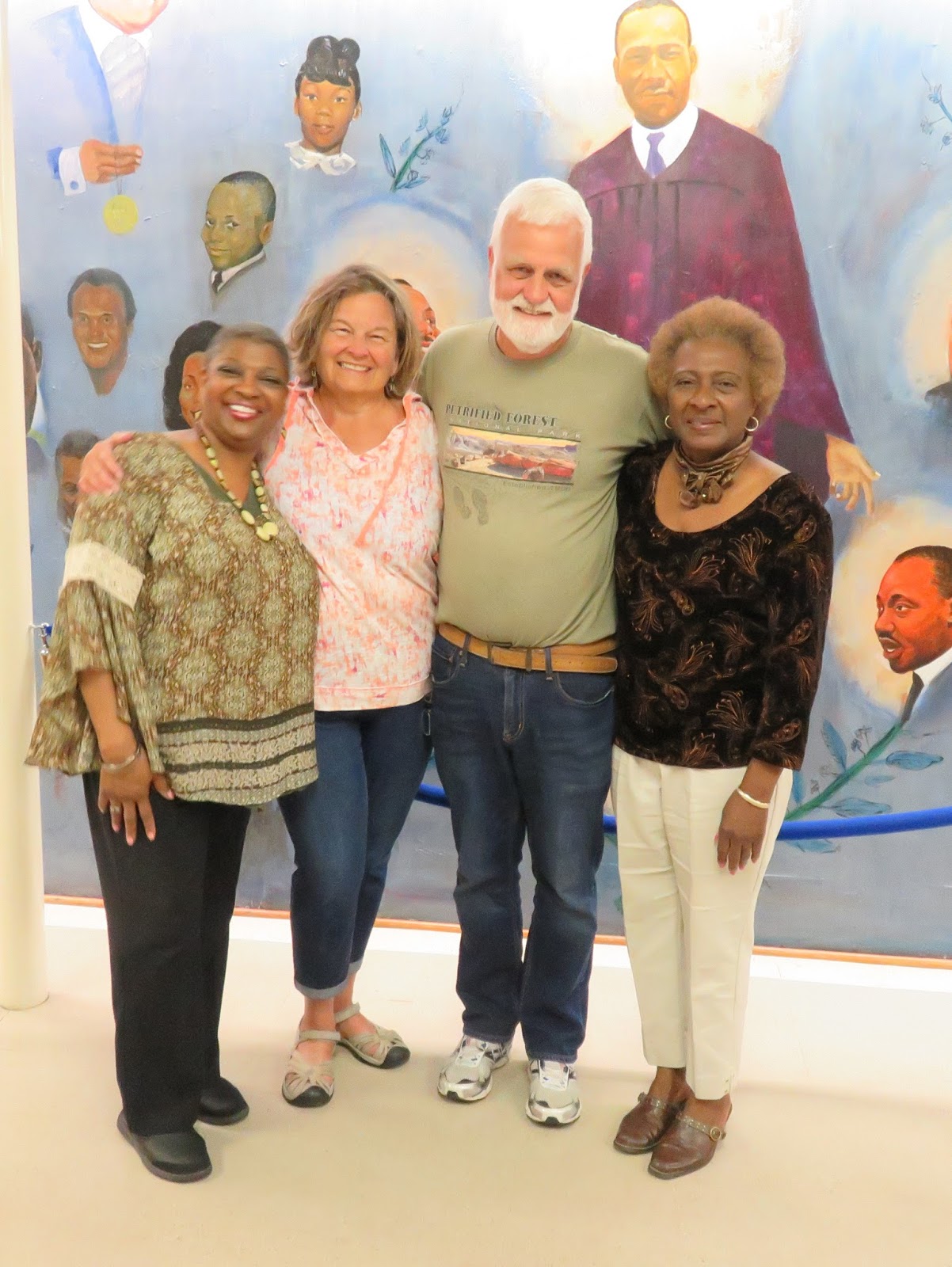
When Jim and I entered Dexter Avenue Church to see about a tour, we were immediately met by a woman with a huge smile and hug.  “Come on in, sugars.”   We were literally “pulled” into the church
Dexter Avenue King Memorial Church


The women hosts at Dexter King
– and escorted through Dr. King’s office where he wrote his sermons, upstairs through the vestibule and sanctuary, and then down again past a beautiful wall-length mural of Dr. King’s life. 
Section of the mural
We were so embraced by the two women we met at this church… it would have been wonderful to have been there for a Sunday service! 

I did leave a little something of myself behind.  They wanted to sing a song together, so we chose “This Little Light of Mine!”   However, they didn’t know all the verses that I had learned at Hawley Methodist!  So, I taught them the verses and actions for two new verses: “Put it under a bushel – No!” and “Don’t let Satan blow it out!”   They were so thrilled to share the verses with their kids’ choir that they insisted on videotaping us singing them!  (Here it is on YouTube! Just click on this title:  “This little light of mine, I’m going to let it shine!

Greyhound Bus Terminal – and the Freedom Riders
I feel the need to say again that I lived through these times, but was oblivious.  Yes, I knew about the Freedom Rides.  But, I realize now that I knew them “as a newspaper headline.”  In other words, I knew the surface, but nothing about the numbers involved and the hatred they encountered. 

The basic idea of the “Freedom Ride” was for teams of blacks and whites to ride regularly scheduled interstate buses from Washington, D.C. to New Orleans, sitting together on the bus, in waiting rooms, and eating together at bus station cafes.  They wanted to compel the Federal government to help enforce a court case called “Boynton vs. Virginia” that declared segregation in bus terminals unconstitutional.  

They met with such violence along the way.  One of the buses was fire-bombed near Anniston, Alabama and the riders beaten as they struggled off the burning bus.
Bus fire-bombed in Anniston, Alabama
And,  here's what happened in Montgomery:  On May 20, 1961, a group of black and white riders led by John Lewis left Birmingham on a Greyhound bus.  Upon arriving in Montgomery, their police escort “disappeared” and it is widely known that the local police chief gave the local Klan 15 minutes to do what they wanted.  An angry mob of over 200 Klan supporters attacked and injured the riders.  The most severely beaten rider was a young man from Appleton, Wisconsin -- Jim Zwerg, attacked most savagely because he was white. 
Jim Zwerg


The violence was so bad in Birmingham, Montgomery and Anniston that the Freedom Ride was called off.  But, national coverage of the ride brought the world’s attention.  And, Attorney General Robert F. Kennedy was so enraged by what occurred here that he became personally active in the movement.  During the summer and fall, hundreds of others took up the Freedom Rides.  On November 1, 1961, the ICC put out new regulations guaranteeing integration of interstate buses and stations - an unqualified victory.

Dexter Parsonage Museum.  

Dexter Church Parsonage
The King family lived in this parsonage from 1954 to 1960.  Two of their four children were born while living in this house.  Of all the places we went, we could have skipped this one as it mainly involved walking through a small house.  More stories were told about the period possessions inside than the Kings.  But, what stories were told gave glimpses of him as husband and father.  The most poignant story:  Martin always sent Coretta flowers when he was away.  On his last fateful trip to Memphis, he sent her plastic flowers.  Why not real flowers? she asked him on the phone.  He answered: “These will last if I have to stay away longer this time.”

What struck me the most was realizing that he was only 24 years of age and only two months married when he was called to preach at this, his first church.  How very young!  How newly married!  Yet both he and Coretta so quickly became leaders - and faces – of the civil rights struggles in Montgomery.  You can still see the crater on the front porch left by a dynamite blast set off while Coretta was home with their new baby Yolanda.  (His brother’s house was also bombed in Birmingham; the perpetrators never found for either.)

But of all the stories told at the parsonage, the one that sticks in my head and heart the most had nothing to do with the Kings.  The woman who greeted us and started the tour told us a little about her own life.  Her mother was a domestic worker.  One of her mother’s jobs for her employer was to wash and iron his KKK robes!  At this time of lynchings and beatings, I cannot imagine the horror she must have felt as she handled, washed and ironed those robes. 
She always told her daughter: “The best way we can overcome this is to use the money I am making from washing his clothes for you to go to college.”  And, the daughter did.  A woman about my age, she eventually got her Masters in Library Science.  How justifiably ironic as she herself had not been allowed to enter a public library as a child!

Montgomery Bus Boycott. 
Artist sketch: Montgomery Boycott
We didn’t go to the Rosa Parks museum; our time just ran out.  Rosa Parks is worth mentioning, of course.  On December 1, 1955, she was arrested for refusing to surrender her seat to a white man.  She was not the first to refuse, but her arrest sparked the launch of the Montgomery Bus Boycott the next day after a meeting in the basement of the Dexter Avenue Church.  And, Dr. King - at the age of 25 - became the national face of the movement. 

As a person who has devoted her career to helping organizations be clear about their purpose and strategies, I am impressed with the simple eloquence of Dr. King’s.  Building on Gandhi and other people’s ideas, King’s new strategy launched that night was called: “non-violent, direct action.”   He believed in non-violence, but not passivity.  They were to directly confront, but never resort to violence.  The Montgomery Bus Boycott was a prime example.  What really impresses me about the boycott were the 50,000 black citizens who joined in.  These ordinary people – mostly domestic workers - walked 381 consecutive days rather than ride, before a judge ordered integration of the city’s buses.  

Our first stop - Tuskegee

After leaving admittedly posh Perdido Key, we drove straight through to Tuskegee, Alabama.  Our drive into town showed a town of poverty – most businesses, most buildings had their doors and windows boarded up or broken.  (Later, we saw other areas around Tuskegee Institute in much better condition.) 

We went immediately to the Tuskegee History Museum to learn more about the syphilis study. But I learned oh so much more.  I am going to start with what I learned about the history of our laws relative to Civil Rights in America.  I had had no idea how many laws were passed -- after passage of the 13th, 14th and 15th Amendments to our Constitution!

Civil Rights Acts- 100 years, and counting
I grew up in school learning that the 1964 Civil Rights Act and 1965 Voting Rights Acts were both landmark pieces of legislation (i.e. momentous steps forward for civil rights).  And, they were... but I was not taught that almost identical Acts had passed almost 100 years earlier!  Throughout American history, several pieces of legislation have been called The Civil Rights Act. The first passed in 1866! 
  •      The Civil Rights Act of 1866 declared that all persons born in the United States were citizens, regardless of race, color or “previous condition” (i.e. slave or free).  President Andrew Johnson vetoed this bill saying that Blacks were not qualified to be citizens.  Congress overrode his veto and it became law. Blacks were given full citizenship – and were guaranteed the right to own private property, enter contracts, vote, etc.
  •       The Civil Rights Act of 1870.  Congress banned the use of terror, force or bribery to prevent someone from voting.  Military help was sent to the South to enforce the law… and thousands of Blacks registered to vote for the first time. 
  •       The Civil Rights Act of 1871 outlawed discrimination in public accommodation on the basis of race.  (This law was later deemed unconstitutional because the Supreme Court said that the Constitution couldn’t cover acts of individuals.)
  •      The Civil Rights Act of 1957.  This act reaffirmed Black voting rights, the end to de facto segregation, and provided equal housing rights.  While weak in enforcement, it opened the door for lawsuits to compel compliance.
  •      The Civil Rights Act of 1960.  Established federal inspection of local polls and introduced penalties for obstructing a person’s right to register to vote, or actually to vote.
  •      The Civil Rights Act of 1964.  Outlawed segregation in schools and public places.
  •      National Voting Rights Act of 1965.  Outlawed the use of literacy tests to qualify to vote, and allowed for Federal registration in areas with fewer than 50% of minority voters deemed eligible to vote.
I wrote all these Acts down because I was horrified by what people lived through – and the hundreds who died –  to get full and final recognition as human beings.  The degrees to which states and individuals went to thwart these laws were unreal.

Think about these Acts as you read about this stop and each of the next … and the timing.  For example, I’ve already covered how in Biloxi, Blacks weren’t allowed on the beach until 1968!  I’ve covered how people were arrested in Hattiesburg in 1964 for attempting to order lunch.  We should remember --- and know that more work remains before The Dream is fully realized in our beloved country.

Syphilis Study

Jim and I knew of the Tuskegee syphilis study, but we wanted to learn more.  Basically, starting in 1932, the United States public health system conducted “an experiment” on African-American men of the Tuskegee area.  The government said that people could be treated for any health symptoms free if they would participate in a study.  A local, trusted
Dr. Vonderlehr and Nurse Rivers
nurse named Eunice Rivers encouraged people to come in for a screening.
  The screening included a spinal tap – without anesthetic!  Contrary to what I had thought, people were not injected with syphilis.  But, if they were found be a carrier, they were purposefully not treated -- even after penicillin became widely available and was known to cure it.  

Dr. Vonderlehr, the study’s lead, wanted to watch patients’ progression until their death in order to autopsy their corpses.  And, the study continued …. for forty years!  Even when a man moved away to other cities, the doctors in the new locations were told not to treat him with penicillin.  After Dr. Vonderlehr retired, others doctors continued the study.  

All of this was done in secret.  None of the participants gave consent, or were ever told they had syphillis.  The story broke July 26, 1972, when Jean Heller wrote an article: “Syphilis Victim in U.S. Study Went Untreated for Forty Years.”  Stated in the singular, there were actually 623 African-American men who were left to live - and die - in agony. 

Charlie Pollard, one of the living “subjects,” sued - and regulations stipulating that medical subjects need to give informed consent became the law of the land. Why were these men targeted?  Because they were poor; they didn’t move away often; they were less educated – and they were Black.

Remember Fred Gray
The attorney who sued on behalf of Charlie Pollard was a man named Fred Gray.  Before this trip, I had never heard of Fred Gray, an early Black attorney.  Through the museums of the South, I couldn’t believe the number of important cases that ended with – “the attorney for the plaintiffs was Fred Gray.”  Here’s a sampling:

  • 1958:  Challenged gerrymandering of Tuskegee City to exclude Blacks from voting (won)
  • 1961: After the severe injuries of Freedom Riders in Alabama by white mobs, Fred Gray sued on behalf of the injured in a suit against Greyhound Bus Company (won)
  • 1963: At the start of school year, Governor George Wallace sent state troopers to block integration of Tuskegee High School. Fred Gray argued a winning case that allowed 16 kids to enroll.  (George Wallace closed the high school for all in a counter move.)
  • 1964:  Fred Gray won a case proving that Macon County jury selection discriminated against Black selection.
  • 1965:  Fred Gray filed the successful suit to ensure police protection of the marchers on the third Selma – Montgomery march
  • 1973:  Fred Gray sued on behalf of Pollard and other syphilis study participants (won)
There were more, but you get the gist.  His quote in the Tuskegee History Museum summed up his strategic use of a law degree: “I set out to destroy anything segregated I could find.”

Rosenwald Schools
The campus of Tuskegee Institute was beautiful, full of stately brick buildings on small hilly grounds.  I knew that this college, helmed originally by Booker T. Washington, became a premier Black university.  What I learned was its role in K-12 education.  

Around the turn of the 20th century, a black child in rural Alabama probably went to school in a small shack, if she went to school. Washington reached out to a white Jewish man named Julius Rosenwald to help him build rural black K-12 schools.  Co-owner of Sears and Roebuck at the time, Rosenwald responded!  Their approach:  If white school boards committed to maintenance and black communities agreed to help in construction, Rosenwald would fund a school. The school had to be architecturally sound for the times: two rooms, big windows allowing natural light,  and good heating/ventilation.  Communities rallied and five thousand Rosenwald schools were built across the former states of the Confederacy and some western states.  

More impressive:  According to economists at the Federal Reserve Bank of Chicago, with time the children who went to Rosenwald schools closed the achievement gap between whites and blacks by two years!  That is, they started three years behind and ended one year behind on grade-level knowledge.  Another little story from history I had never heard that may have lessons for today.

Tuskegee Airmen
After the museum, we went to Moton Field.  Moton Field was the site of flight training for Black military pilot candidates during WW2.  The U.S. Army Air Corps called Moton Field a “military experiment” to see if African-Americans “had the mental and physical abilities as well as the courage to operate and maintain complicated military aircraft.”  They created a nearly complete segregated unit.  As African Americans were needed to fill each job, it became a rare opportunity to learn specialized trades.  Hundreds responded.  The first class had 100 cadets from across the United States. 
In first class of cadets
Ultimately, there were 1000 Tuskegee Airmen and 15,000 support staff.

How did they do?  The military and civil rights success of the Tuskegee Airmen became legendary and is believed to be one of the main reasons that President Harry S. Truman issued Exec Order 9981 to desegregate the US military.

Their story was not an easy one, however.  First commanded by a white officer who argued that the “experiment” should be halted, they were thwarted in getting teachers and aircraft on which to learn.  Then, they got a new commander who said they deserved a chance.  Their final commander was Benjamin O. Davis.  He was one of the first Blacks to graduate from West Point.  (His time at West Point was not easy either.  The entire time he was there, he was subjected to “the silent treatment” from his peers.  He was never spoken to outside of class.)  

Even after the Truman executive order, these airmen were segregated on their bases and, after discharge, at home.  Even officers were not allowed to enter the Officers’ Clubs.  In response, they started the Double V Campaign of World War Two: “Victory abroad against fascism and at home against racism.”  Moton Field became a National Historic Site in 1998, and in 2007 the Tuskegee Airmen received the Congressional Gold Medal, the highest honor bestowed on American citizens. 

Wow! By the end of one afternoon, my head was already spinning.  Jim and I ended the day relaxing at Jim and Nick's Bar-B-Que.
 This was February 28th - as close to my birthday as you could get this year.  What a great way to spend the last day of my 65th year - learning, learning, and learning some more!
Birthday Night Dinner